Conefer, Inc.AI consulting · veteran-led
Albuquerque, New MexicoClients across the country
Corey FrasureThe AI Mad Genius · founder
OpenAI Select Partner

Speaking

You automated the mess.Now it's faster.

A slow mess announces itself. Work piles up, people complain, somebody fixes it. A fast one looks like progress right up until you check the numbers and nothing moved.

Your members have been living in one. Most of them have never had a name for it.

Check a date

21 yrs military14 yrs operations26+ organizations advised

Elapsed · phone call to quote out the doorMON 9:00 AM
Act 1 · The way it’s built
Monday to Thursday.Six offices. The folder waits in every in-tray.

Play it. One customer's request carried through a business, three acts, a clock running the whole time. This is what your room watches while I talk over the top of it. Nobody checks their phone during act two.

02Who's in the room

Owners who already bought AI.

Not a technical audience. Not people deciding whether to start. Most of the room already spent the money, either on purpose or because a vendor switched something on inside software they already pay for. They can't point to what changed, and nobody has given them permission to say so out loud.

Chambers and business groups

Mixed rooms, mixed industries. The one thing everybody shares is a process they run every week that takes too long. That's all the talk needs.

Trade and industry associations

Contractors, agencies, dealers, clinics. Same argument, their vocabulary. Tell me what your members do all day and the examples come from their world, not from a tech company.

Owner peer groups and leadership teams

Smaller, further along, harder to impress. These rooms want the mechanism and the argument, and they'll push back. Good.

Corey volunteers with the New Mexico Veterans Chamber of Commerce. He has been in the folding chairs.

03What the room walks out with

Language for a thing they'd already noticed.

Everybody in that room has felt this and none of them has a name for it. A slow mess announces itself. Work piles up, people complain, somebody fixes it. A fast one looks like progress right up until the numbers get checked and nothing moved.

Give a room the name and they use it on the drive home. That's what makes a talk still be working three weeks later.

What nobody getsNo product demo. No slide at the end with my prices on it. No table in the back. Teaching first is how you earn the right to follow up, and I'd rather be asked back than close somebody at lunch.
How it runsThree moves
01
Somebody sold them a tool and left

The process it landed on had not been looked at in years. One step got quicker. The week stayed exactly as long. Nobody in the room has said this out loud before and every one of them has felt it.

02
Bolted on, or bolted in

Attached to a step nobody examined, or the whole process rebuilt around what the tool makes possible. In the second one, steps stop existing. That's the moment the room goes quiet.

03
The two questions

What do you have to have? What do you want to have? Almost every process anybody has ever fixed only asked the first one. The second is where the interesting part lives.

They leave able to say"We've got a faster mess"

04Formats

Five minutes to a half day.

Same argument at every length. What changes is how much of it the room does themselves.

5min

The opener

One idea and the name for it. Fits an announcements slot or the front of somebody else's programme.

They hear it
15min

The chamber lunch

The problem, the cause, and the distinction between bolted on and bolted in. Ends before the plates are cleared.

They hear it and name one
25min

The breakout

Adds the arithmetic. The room does the math on their own process and finds out the week didn't get shorter.

They do the math
45min

The keynote

The full argument with the examples built for your audience, and time at the end for the questions people only ask once somebody else has asked one.

They work and ask
½day

The workshop

Hands on paper. Everybody maps a process they actually run, then draws it again from a blank page. Caps at twelve so everyone gets looked at.

They leave with it drawn

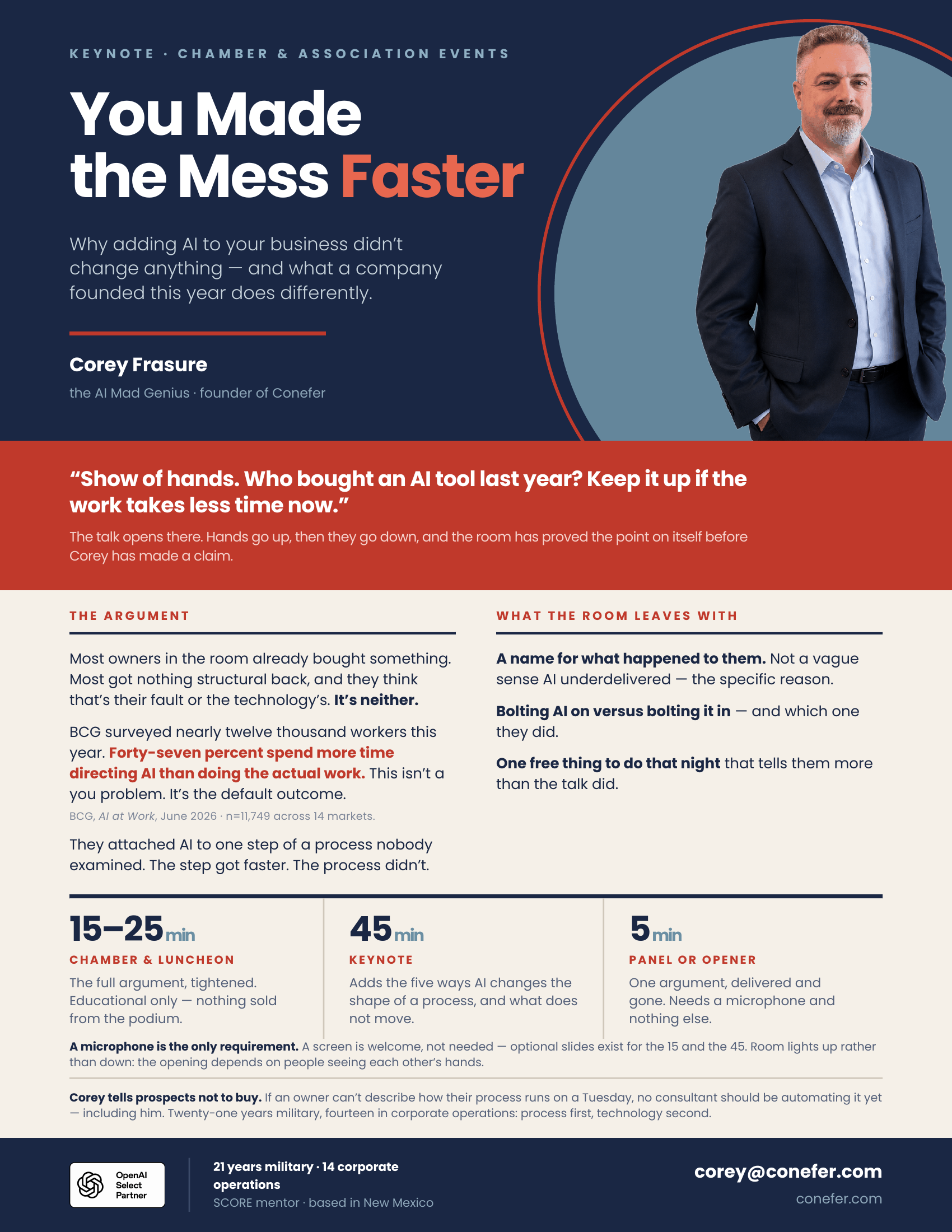
The 45 is the one most conferences want. The 15 is the one chambers book. Virtual works for all of them, and I'll tell you honestly that the half day does not survive a screen.

05Why him

Every consultant sells the rescue. I sell the check.

I've never had to clean up a faster mess. I've never let anyone build one.

"I'll tell you not to buy it" is only credible from someone who could have built it. Conefer is an OpenAI Select Partner and I ship the implementations myself. That's the whole reason a room believes the restraint instead of hearing a consultant with nothing to sell.

21years military
14years corporate operations
26+organizations advised
Case file 02 · training program

Twelve months to find out. Now three.

A sales-training program ran twelve months before anyone knew which new hires were worth keeping. Rebuilt to run in six. At the three-month review the platform's signal already matched the client's own sales figures. This is the example the longer formats work through.

12months it ran
6months rebuilt
3months to signal
Corey Frasure

The AI Mad Genius, founder of Conefer.

AI consultant. Twenty-one years in the military, fourteen in corporate operations. Runs the Conefer Recon, a diagnostic that grades the AI already running in a business and builds what should have been there instead, or says plainly what to stop paying for. Based in New Mexico, speaking across the country.

06For the programme chair

Everything you need to take to your committee.

You're probably not the only person deciding this. Take the whole page if you want, or just the parts below. Copy the bio, grab the headshot, done.

Bios, ready to paste

One line · programme grid

Corey Frasure, the AI Mad Genius, founder of Conefer, Inc. An AI consultant who grades the AI a business already bought, then builds what should have been there instead.

Short · the introduction read from the podium

Corey Frasure is an AI consultant and the founder of Conefer, Inc., an OpenAI Select Partner. He spent twenty-one years in the military and fourteen in corporate operations before he started grading other people’s AI for a living. He has advised more than twenty-six organizations. His argument is that most businesses did not buy a bad tool. They bolted it onto a process nobody had examined in years, and now they have a faster mess. Based in New Mexico. Clients across the country.

Full · programme book and marketing

Corey Frasure, the AI Mad Genius, is the founder of Conefer, Inc., a veteran-led AI consulting firm and an OpenAI Select Partner. He runs the Conefer Recon, a diagnostic that grades the AI already running in a business and builds what should have been there instead, or says plainly what to stop paying for. Twenty-one years in the military and fourteen in corporate operations taught him to look at a process before anyone touches it. More than twenty-six organizations have taken that look with him. He builds the implementations himself, which is what makes it credible when he tells an owner not to buy something. He volunteers with the New Mexico Veterans Chamber of Commerce. Based in New Mexico, speaking across the country.

Files and logistics

Corey Frasure, mid-sentence, in a blue shirt and dark jacket
Corey Frasure · mid-sentence, as usual
What I need in the room
Screen or projectorHDMI
MicrophoneLapel or handheld
I bringLaptop, clicker
HandoutsOnly if you want them

Room of forty or fewer with decent acoustics, skip the microphone. Tell me what you've got and I'll plan around it.

Questions chairs actually ask

Will this turn into a sales pitch?

No. No product demo, no slide at the end with prices on it, no table in the back. Your members get taught something they can use, and if one of them wants to keep talking afterward, that is their move to make. Put it in the agreement if you want it in writing. I will sign that.

My members are contractors and shop owners. Is this too technical?

It is built for people who own a business, not people who build software. Nobody has to know what a model is. The whole talk runs on one thing everyone in the room already has: a process they run every week that takes longer than it should.

Do you change the talk for our audience?

Yes, and I will ask you for what I need to do it. Who is in the seats, what they do all day, what they already tried. A talk built for a general business audience and delivered to a room of plumbing contractors is the reason your members stop coming to lunch.

How far ahead do we need to book?

A chamber lunch can come together in a couple of weeks. A conference slot usually wants more room than that. Ask either way, and I will tell you straight if the date does not work.

What do you need from us?

A screen or a projector, and a lapel or handheld microphone in a room bigger than about forty people. I bring my own laptop and clicker. If the room has none of that I can still work; tell me in advance and I will plan for it.

07Check a date

Tell me about the room.

Three things to start. The event details come after, and skip any you don't know yet. I answer these myself.

Before you do I'm the wrong call if you want a technology update. If the brief is "tell our members what's new in AI," book somebody else and they'll do it better. This talk only works on a room that runs something. And if your members would rather be sold to than taught, I'll waste your slot.

Chamber lunch in three weeks? Ask. Conference next spring? Also ask. I'd rather tell you a date doesn't work than have you wondering.

Step 1 of 2 Who you are

No pitch, no list. This goes to me.